| dc.contributor.author | Bahtlı, Tuba | |
| dc.contributor.author | Bostancı, Veysel Murat | |
| dc.date.accessioned | 2025-02-11T07:24:24Z | |
| dc.date.available | 2025-02-11T07:24:24Z | |
| dc.date.issued | 27.02.2024 | en_US |
| dc.identifier.citation | Bahtlı, T., & Bostancı, V. M. (2024). 7131 Çeliğinin Hassas Dökümünden Elde Edilen Döküm Atık Kumu Katılarak Şamot Refrakter Üretimi. Afyon Kocatepe Üniversitesi Fen Ve Mühendislik Bilimleri Dergisi, 24(1), 126-135. https://doi.org/10.35414/akufemubid.1283088 | en_US |
| dc.identifier.uri | https://dergipark.org.tr/tr/pub/akufemubid/issue/83319/1283088 | |
| dc.identifier.uri | https://hdl.handle.net/11630/12247 | |
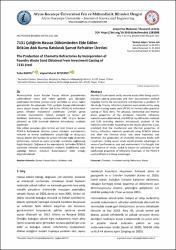
| dc.description.abstract | Alüminasilikat esaslı kalıplar hassas döküm proseslerinde kullanıldıktan sonra atık haline gelerek, geri dönüşüm yapılmadan birikmesi çevreye zarar vermekte ve sorun haline gelmektedir. Bu çalışmada, 7131 çeliğinin hassas dökümünden sonra oluşan hassas döküm atık kumu (PCWS-A) kullanılarak şamot refrakter malzemeler üretilmiştir. Üretilen şamot refrakter malzemelerin fiziksel, mekanik ve termal şok özellikleri belirlenmiş, malzemelerinin XRD (X-ışını kırınım yöntemi) ve SEM (taramalı elektron mikroskobu) analizleri yapılmıştır.
Elde edilen sonuçlara göre termal şok testi öncesi ve sonrası PCWS-A kullanılarak üretilen şamot refrakter malzemelerin mekanik ve termal özelliklerinin iyileştirildiği ve dolayısıyla hassas döküm atık kumları ile şamot refrakter tuğla üretiminin performans, maliyet ve çevre açısından avantajlar sağlayacağı öngörülmüştür. Sağlanacak bu avantajlarda, kullanılan PCWS-A içerisinde refrakter malzemelerin mekanik özelliklerine katkı sağladığı bilinen zirkonun bulunmasının etkili olduğu düşünülmektedir. | en_US |
| dc.description.abstract | Alumina Silicate based molds become waste after being used in precision casting processes, and their accumulation without recycling harms the environment and becomes a problem. In this study, fireclay refractory materials were produced by using precision casting waste sand (PCWS-A) formed after precision casting of 7131 steel. The physical, mechanical and thermal shock properties of the produced chamotte refractory materials were determined, and XRD (X-ray diffraction method) and SEM (scanning electron microscope) analyzes of the materials were made. According to the results obtained, it was predicted that the mechanical and thermal properties of fireclay refractory materials produced using PCWS-A before and after the thermal shock test were improved, and therefore, the production of chamotte refractory bricks with investment casting waste sands would provide advantages in terms of performance, cost and environment. It is thought that the presence of zircon, which is known to contribute to the mechanical properties of refractory materials, in the PCWS-A used is effective in these advantages | en_US |
| dc.language.iso | tr | |
| dc.publisher | Afyon Kocatepe Üniversitesi | en_US |
| dc.relation.ispartof | Afyon Kocatepe Üniversitesi Fen ve Mühendislik Bilimleri Dergisi | |
| dc.identifier.doi | 10.35414/akufemubid.1283088 | |
| dc.rights | info:eu-repo/semantics/openAccess | en_US |
| dc.subject | Şamot | en_US |
| dc.subject | Hassas döküm | en_US |
| dc.subject | Refrakter | en_US |
| dc.subject | Atık | en_US |
| dc.title | 7131 çeliğinin hassas dökümünden elde edilen döküm atık kumu katılarak şamot refrakter üretimi | en_US |
| dc.title.alternative | The production of chamotte refractories by ıncorporation of foundry waste sand obtained from ınvestment casting of 7131 steel | en_US |
| dc.type | Article | |
| dc.department | Seçiniz | en_US |
| dc.identifier.orcid | 0000-0001-5682-6280 | en_US |
| dc.identifier.orcid | 0000-0001-9704-6467 | en_US |
| dc.identifier.volume | 24 | en_US |
| dc.identifier.startpage | 126 | en_US |
| dc.identifier.endpage | 135 | en_US |
| dc.identifier.issue | 1 | en_US |
| dc.relation.publicationcategory | Makale - Ulusal Hakemli Dergi - Başka Kurum Yazarı | en_US |