| dc.contributor.author | Coşkun, Muhammed | |
| dc.date.accessioned | 2025-09-05T07:51:46Z | |
| dc.date.available | 2025-09-05T07:51:46Z | |
| dc.date.issued | 15.06.2025 | en_US |
| dc.identifier.citation | Coşkun, M. (2025). Qurʾānic Mushrikūn Between Monotheism and Idolatry. Kocatepe İslami İlimler Dergisi, 8(1), 84-95. https://doi.org/10.52637/kiid.1620105 | en_US |
| dc.identifier.uri | https://dergipark.org.tr/tr/pub/kiid/issue/92409/1620105 | |
| dc.identifier.uri | https://hdl.handle.net/11630/13183 | |
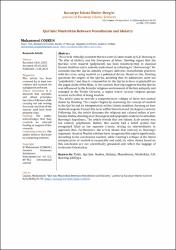
| dc.description.abstract | This article critically examines the two central claims made by G.R. Hawting in The Idea of Idolatry and the Emergence of Islam. Hawting argues that the Qur’ānic term mushrik (polytheist) has been misinterpreted in classical Islamic tradition and is entirely understood as referring to "idol worship." He contends that the Qur’ān actually critiques defective monotheistic practices with this term, using mushrik as a polemical device. Based on this, Hawting questions the origins of the Qur’ān, asserting that its addressees were not "polytheistic," and thus it is impossible for the Qur’ān to have originated from the pagan Arabs of the Hijaz. In this context, Hawting suggests that the Qur’ān was influenced by the broader religious environment of the late antiquity and emerged in the Fertile Crescent, a region where various religious groups accused each other of being mushrik.
This article aims to provide a comprehensive critique of these two central claims by Hawting. This chapter begins by examining the concept of mushrik in the Qur’ān and its interpretation within Islamic tradition, focusing on how classical exegesis framed this term within historical and theological contexts. Following this, the article discusses the religious and cultural milieu of pre-Islamic Arabia, drawing on archeological and epigraphic evidence to articulate Hawting’s hypothesis. The article reveals that pre-Islamic Arab society was not entirely polytheistic. Rather, this society had a belief system that recognized Allah as the supreme creator, relying on intermediaries to approach Him. Furthermore, the article shows that contrary to Hawting’s argument, classical Muslim scholars have recognized this aspect significantly. According to the conclusions reached, while Hawting’s critique of the literal interpretation of mushrik is reasonable and valid, his other claims based on this conclusion are not scientifically grounded and reflect the baggage of revisionist Orientalism. This article aims to provide a comprehensive critique of these two central claims by Hawting. This chapter begins by examining the concept of mushrik in the Qur’ān and its interpretation within Islamic tradition, focusing on how classical exegesis framed this term within historical and theological contexts. Following this, the article discusses the religious and cultural milieu of pre-Islamic Arabia, drawing on archeological and epigraphic evidence to articulate Hawting’s hypothesis. The article reveals that pre-Islamic Arab society was not entirely polytheistic. Rather, this society had a belief system that recognized Allah as the supreme creator, relying on intermediaries to approach Him. Furthermore, the article shows that contrary to Hawting’s argument, classical Muslim scholars have recognized this aspect significantly. According to the conclusions reached, while Hawting’s critique of the literal interpretation of mushrik is reasonable and valid, his other claims based on this conclusion are not scientifically grounded and reflect the baggage of revisionist Orientalism. | en_US |
| dc.description.abstract | Bu makale, G.R. Hawting'in The Idea of Idolatry and the Emergence of Islam adlı eserinde ileri sürdüğü iki temel iddiayı eleştirel bir şekilde incelemektedir. Hawting, Kur'an'daki müşrik teriminin, klasik İslam geleneğinde yanlış yorumlandığını ve bütünüyle “putperestlik” olarak anlaşıldığını savunur. Ona göre Kur'an bu ifade ile aslında kusurlu tek tanrıcılık uygulamalarını eleştirir ve müşrik kelimesini bir polemik unsuru olarak kullanır. Buradan hareketle Kur'an'ın kökenlerini sorgulamaya girişen Hawting, ikinci temel iddia olarak Kur’an metninin muhataplarının “çok tanrıcı” olmadıklarını, dolayısıyla onun pagan Arapların yaşadığı Hicaz’dan neşet etmiş olmasının imkânsız olduğunu savunur. Bu çerçevede Hawting Kur’an’ın geç antikçağın daha geniş dini bağlamından etkilendiğini ve çeşitli dini grupların birbirlerini müşrik olmakla suçladığı verimli hilal bölgesinde ortaya çıktığını öne sürer.
Hawting’in bu iki temel iddiasıyla ilgili kapsamlı bir eleştiri sunmayı hedefleyen bu makale, öncelikle Kur'an'daki müşrik kavramını ve bu kavramın İslam geleneğindeki yorumlanışını incelemekte, klasik tefsirin bu terimi tarihsel ve teolojik bağlamlarda nasıl yorumladığını ele almaktadır. Bunun akabinde makale, İslam öncesi Arap dünyasının dini ve kültürel ortamını arkeolojik ve epigrafik kanıtlarla değerlendirerek, Hawting'in hipotezini tartışmaktadır. Makale İslam öncesi Arap toplumunun tamamen çoktanrıcı olmadığını, aksine bu toplumun Allah'ı en yüce yaratıcı olarak kabul eden ve O’na ulaşmak için edinilmiş aracılara dayanan bir inanç sistemine sahip olduğunu ortaya koyar. Ayrıca makalede bu durumun Hawting’in öngördüğünün aksine, klasik İslam bilginleri tarafından da önemli ölçüde fark edilmiş olduğu tespit edilir. Ulaşılan sonuca göre Hawting'in müşrik teriminin harfi harfine yorumlanmasına yönelik eleştirisi makul ve geçerli olsa da onun bu sonuca dayanarak ulaştığı diğer iddia bilimsel olarak temellendirilememekte, aksine revizyonist oryantalizmin bagajını yansıtmaktadır. | en_US |
| dc.language.iso | en | |
| dc.publisher | Afyon Kocatepe Üniversitesi | en_US |
| dc.relation.ispartof | Afyon Kocatepe Üniversitesi İslami İlimler Dergisi | |
| dc.identifier.doi | 10.52637/kiid.1620105 | |
| dc.rights | info:eu-repo/semantics/openAccess | en_US |
| dc.subject | Tafsīr | en_US |
| dc.subject | Qurʾanic studies | en_US |
| dc.subject | Idolatry | en_US |
| dc.subject | Monotheism | en_US |
| dc.subject | Mushrikūn | en_US |
| dc.subject | G.R. Hawting | en_US |
| dc.subject | Jahiliya | en_US |
| dc.subject | Tefsir | en_US |
| dc.subject | Kur’an araştırmaları | en_US |
| dc.subject | Putperestlik | en_US |
| dc.subject | Tektanrıcılık | en_US |
| dc.subject | G.R.Hawting | en_US |
| dc.subject | Cahiliye | en_US |
| dc.title | Qurʾānic mushrikūn between monotheism and ıdolatry | en_US |
| dc.title.alternative | Putperestlik ve tektanrıcılık arasında Kur’an’ın müşrikler kavramı | en_US |
| dc.type | Article | |
| dc.department | Seçiniz | en_US |
| dc.identifier.orcid | 0000-0001-5613-2182 | en_US |
| dc.identifier.volume | 8 | en_US |
| dc.identifier.startpage | 84 | en_US |
| dc.identifier.endpage | 95 | en_US |
| dc.identifier.issue | 1 | en_US |
| dc.relation.publicationcategory | Makale - Ulusal Hakemli Dergi - Başka Kurum Yazarı | en_US |